Bioinformatics Job Market 2026: The Skills That Actually Get You Hired (and the Ones That Don’t)

Bioinformatics Job Market 2026: The Skills That Actually Get You Hired (and the Ones That Don’t)
If you’re a bioinformatician (or aspiring to become one) and you’re wondering whether 2026 is going to be a good year to find a job – the short answer is yes, but only if you have the right skills.
The market is starving for people who can actually ship production-grade pipelines, not just write another Jupyter notebook that only runs on their laptop. Companies are throwing money at the skill gap: there are tens of thousands of unfilled roles worldwide while hundreds of applicants per posting still get rejected because they lack practical, industry-ready experience.
Here’s the no-hype, data-backed reality for 2026 – straight from recent reports, job-market analyses, and what hiring managers are actually saying.
1. The Market Snapshot (It’s Growing – But Selectively)
- Growth: U.S. Bureau of Labor Statistics projects ~15% growth for bioinformatics-related roles (computational biology, biological scientists, data scientists in life sciences) through 2032 – well above the national average. Some sub-fields like biostatistics are hitting 35%. The global bioinformatics market itself is growing at 11-13% CAGR.
- Reality check: Overall biotech hiring is still cautious after the 2023-2025 funding crunch, but bioinformatics and data-science roles are the exception. BioSpace’s 2026 Life Sciences Employment Outlook and multiple industry surveys show bioinformatics skills are among the top 3 hardest-to-fill categories in pharma and biotech.
- Hot sectors (in order of hiring volume):
- Pharma & large biotech (drug discovery, oncology, rare disease)
- Precision medicine / clinical genomics (hospitals, diagnostic companies)
- AI-driven drug discovery startups
- Agricultural biotech & synthetic biology
- Academic core facilities (still hiring, but lower pay)
Salaries (US, 2026 estimates)
- Junior/Mid-level (0–4 yrs): $85k–$120k
- Senior/Lead: $130k–$165k
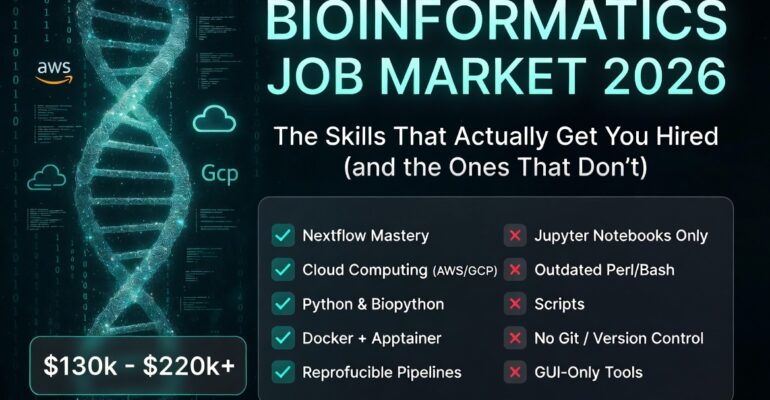
- Staff/Principal + AI/cloud specialists in Bay Area/Boston: $170k–$220k+ (total comp with equity) Europe and remote roles are 20–35% lower but still very competitive.
The message is clear: if you can turn raw FASTQ into biologically meaningful, reproducible results at scale, you will get multiple offers. If you can’t – good luck competing with the 150 other applicants.
2. Skills That Actually Get You Hired in 2026
These are the ones recruiters and hiring managers repeatedly mention in 2025-2026 job postings and surveys.
Must-Have Technical Skills (ranked by demand)
- Python (non-negotiable #1) Pandas, NumPy, SciPy, scikit-learn, Biopython. You should be able to write clean scripts and packages, not just notebooks.
- Workflow orchestration: Nextflow or Snakemake If you only know one, make it Nextflow – it dominates industry postings in 2026. Being able to write, maintain, and debug DSL2 pipelines that run on HPC, AWS Batch, or Google Batch is pure gold.
- Cloud computing (AWS or GCP – pick one and go deep) IAM roles, S3/Cloud Storage, Batch/Compute Engine, cost optimization, Terra/Batch workflows. Companies no longer want “works on my machine” people.
- Containers: Docker + Apptainer/Singularity Every serious job now requires you to build and run containerized pipelines that survive cluster outages and security scans.
- Modern NGS ecosystem GATK best practices, SAMtools/BCFtools, STAR or HISAT2, DESeq2/edgeR or Seurat (for scRNA), MultiQC, FastQC. Bonus: long-read tools (Minimap2, Flye, Medaka) and spatial transcriptomics (SpaceRanger, Seurat + spatial packages).
- Machine Learning applied to biology (not generic ML) PyTorch or TensorFlow for genomics (variant effect prediction, AlphaFold-like models, single-cell integration). The key phrase in 2026 postings: “ML experience with biological validation.”
- Git + reproducibility practices Proper branching, CI/CD for pipelines, Conda/Mamba or Poetry environments, documentation that a new team member can actually understand.
- Multi-omics integration & biological interpretation This is what separates $90k analysts from $150k+ scientists. Knowing how to combine RNA-seq + ATAC-seq + proteomics and then explain the biology to a wet-lab PI or clinician.
Soft Skills That Close the Deal
- Ability to communicate results to non-computational biologists (figures, Slack explanations, presentations).
- Understanding of regulatory/clinical context (HIPAA, FDA, CLIA, GDPR) if you want clinical or pharma roles.
- Portfolio on GitHub that actually works (public pipelines with test data, READMEs with runtime/cost benchmarks).
3. Skills That Don’t Get You Hired Anymore (and Might Hurt You)
- “I know 8 programming languages” → nobody cares. Depth in Python + one workflow language beats breadth.
- Only academic publications with no production pipelines.
- GUI-only experience (Galaxy, CLC Genomics, Excel dashboards).
- “I did some ML on Kaggle” with zero biological validation or domain knowledge.
- Outdated tools: old Perl scripts, custom Bash monstrosities from 2015, no version control.
- Pure wet-lab biologists who “learned a bit of R in grad school” and expect the same salary as a real bioinformatician.
- No cloud experience in 2026 = instant filter for most industry roles.
Hiring managers have seen too many candidates who can talk about AlphaFold but can’t scale a simple variant-calling pipeline to 500 samples without crashing the cluster.
4. How to Actually Get These Skills (Practical 2026 Roadmap)
If you’re graduating in 2026:
- Build 3-4 production-ready projects on GitHub (e.g., end-to-end scRNA-seq, WGS variant calling with Nextflow on AWS, multi-omics integration).
- Contribute to an open-source pipeline.
- Do at least one internship.
Mid-career switchers:
- Take a targeted course (e.g., Nextflow, AWS for Scientists, or a short bootcamp) and immediately apply it to a real dataset from your lab.
- Containerize your existing pipeline and put the Docker + Nextflow repo public.
Senior folks looking to level up:
- Learn to lead cloud migrations or AI-augmented pipelines. That’s where the $160k+ roles are.
Final Reality Check
The 2026 bioinformatics job market rewards practical engineers who understand biology, not pure coders or pure biologists.
If you can:
- Write a Nextflow pipeline that runs on 10,000 samples in the cloud for under $X,
- Interpret the results biologically,
- Put it all in a reproducible GitHub repo with clear docs,
…you will be in the top 5% of candidates and get offers quickly.
If you’re still doing everything in RStudio on your laptop with no Git history and no cloud experience — the market will be brutal.
The tools and the data are there. The question is whether you’re willing to ship real, production-grade work in 2026.
Start today. Pick one pipeline from your current project, containerize it, rewrite it in Nextflow, deploy it to AWS Batch, and push it to GitHub. That single project will open more doors than another certificate ever will.
Good luck my friend
References:
- McBride B. Bioinformatics in 2026: What to Expect [Internet]. Edinburgh: Fios Genomics; 2026 Jan 9 [cited 2026 Feb 24]. Available from: https://www.fiosgenomics.com/bioinformatics-in-2026-what-to-expect/
- Bioinformatics Home. Updated Career Outlook: Data and Bioinformatics Scientists to 2026 and Beyond [Internet]. 2024 Apr 28 [cited 2026 Feb 24]. Available from: https://bioinformaticshome.com/blog/career_2026.html
- Research.com. 2026 Is Demand for Bioinformatics Degree Graduates Growing or Declining? [Internet]. 2026 Feb [cited 2026 Feb 24]. Available from: https://research.com/advice/is-demand-for-bioinformatics-degree-graduates-growing-or-declining
- U.S. Bureau of Labor Statistics. Occupational Outlook Handbook – Computer and Information Research Scientists [Internet]. Washington, DC: BLS; 2024 [cited 2026 Feb 24]. Available from: https://www.bls.gov/ooh/computer-and-information-technology/computer-and-information-research-scientists.htm
- Bversity. Top 3 Skills in Bioinformatics to Secure a Job in 2026 [Internet]. 2025 Dec 18 [cited 2026 Feb 24]. Available from: https://bversity.io/blog/skills-in-bioinformatics-to-secure-a-job-in-2026
- BioSpace. Report: 2026 Employment Outlook [Internet]. 2026 Jan 28 [cited 2026 Feb 24]. Available from: https://www.biospace.com/report-2026-employment-outlook
- Insight Global. 11 Leading Life Sciences Jobs Hiring in 2026 [Internet]. 2025 Sep 5 [cited 2026 Feb 24]. Available from: https://insightglobal.com/blog/11-hiring-life-sciences-jobs/
- Northeastern University Graduate Programs. 7 Popular Bioinformatics Careers [Internet]. 2024 Jul 9 [cited 2026 Feb 24]. Available from: https://graduate.northeastern.edu/knowledge-hub/top-bioinformatics-careers/