
Reproducible NGS Pipelines: Why Your Results Should Survive a Power Outage

Reproducible NGS Pipelines: Why Your Results Should Survive a Power Outage
Introduction
If you’ve ever lost days of next-generation sequencing (NGS) analysis to a server crash or a forgotten parameter, you already know the pain of non-reproducible pipelines. Reproducibility isn’t a luxury-it’s the backbone of bioinformatics. A reproducible NGS pipeline ensures that your results can be rerun, verified, and trusted, even after a power outage or a system migration.
The Hidden Problem: Fragile NGS Workflows
Too many bioinformatics workflows live as messy folders full of random shell scripts and filenames like final_version_really_final.sh. When that system fails, nobody—not even the original author—can reproduce what happened.
A study by Stodden et al. found that fewer than 40% of computational biology papers could be fully reproduced, even when their code and data were shared [1]. Reproducibility in NGS analysis isn’t optional anymore; it’s how you prove that your findings are real.
Why Reproducibility Matters in NGS Analysis
NGS analysis includes several complex steps-each dependent on software versions, parameters, and reference files:
- Quality control (FastQC, MultiQC)
- Trimming (Trimmomatic, Cutadapt)
- Alignment (BWA, HISAT2, STAR)
Change one version, one setting, or one genome build, and your downstream results shift. Reproducible pipelines guarantee that every run-on any system-produces identical results.
Top Tools for Building Reproducible Bioinformatics Pipelines
1. Workflow Managers: Nextflow, Snakemake, CWL, WDL
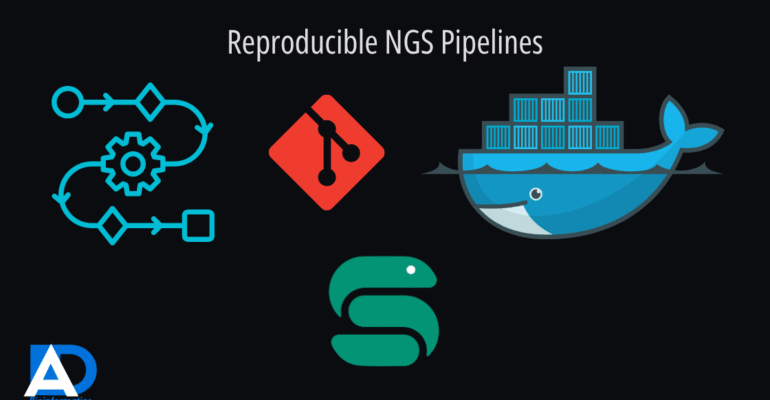
Workflow engines like Nextflow and Snakemake automate each step of your NGS pipeline with defined dependencies. Snakemake builds a reproducible task graph [2], while Nextflow allows seamless scaling from a laptop to a high-performance cluster or cloud [3]. Both support version control, automatic checkpoints, and reproducible configurations.
2. Containerization: Docker and Singularity
Containers isolate your pipeline’s software environment. Docker works best for development, while Singularity dominates HPC systems [4]. Containers ensure that software versions and dependencies remain identical everywhere-no more dependency nightmares.
3. Version Control: Git and GitHub
Track every command, every change, every idea. Using Git guarantees that your code and parameters are documented, recoverable, and shareable-essential for reproducibility.
4. Metadata Management
Define parameters, file paths, and sample IDs in structured files (YAML or JSON). Store them with your code so anyone can rerun the pipeline exactly as you did.
5. Provenance and Logging
Keep automatic logs of every step, software version, and system detail. Tools like ReproZip or SnakeMake can capture complete provenance for reproducibility audits [5].
When Pipelines Survive Power Outages
A true reproducible pipeline can resume after a crash without data loss. Workflow managers track progress, skip completed steps, and restart precisely where they left off. Your analysis becomes resilient-portable between servers, teams, or even decades.
That’s not overengineering; it’s responsible science.
Why It Matters Beyond Your Lab
Standardized, reproducible workflows form the major projects like ENCODE, GTEx, and TCGA. When your methods are transparent and rerunnable, your research contributes to a global body of verifiable science something every bioinformatics researcher should strive for.
Conclusion
Unreproducible results are scientific ghosts-beautiful once, but impossible to resurrect. Reproducible NGS pipelines are your insurance policy against crashes, hardware failures, and time. By using workflow managers like Nextflow, Snakemake, and Docker containers, you ensure that your analyses outlive your hardware, your institution, and maybe even your career.
If your bioinformatics pipeline can’t survive a power outage, it’s not really a pipeline-it’s kind of a gamble.
References
- Stodden V, Seiler J, Ma Z. An empirical analysis of journal policy effectiveness for computational reproducibility. Proc Natl Acad Sci USA. 2018;115(11):2584–2589.
- Köster J, Rahmann S. Snakemake—a scalable bioinformatics workflow engine. Bioinformatics. 2012;28(19):2520–2522.
- Di Tommaso P, Chatzou M, Floden EW, Barja PP, Palumbo E, Notredame C. Nextflow enables reproducible computational workflows. Nat Biotechnol. 2017;35(4):316–319.
- Kurtzer GM, Sochat V, Bauer MW. Singularity: Scientific containers for mobility of compute. PLoS One. 2017;12(5):e0177459.
- Chirigati F, Rampin R, Shasha D, Freire J. ReproZip: Computational reproducibility with ease. Proc 2016 ACM SIGMOD. 2016;2085–2088.