VarSage: AI-Powered Exome Variant Prioritization for WES

Whole-exome sequencing can identify tens of thousands of genetic variants in a single individual. The difficult part is rarely generating those variants-it is determining which of them are biologically and clinically relevant.
Variant interpretation traditionally requires researchers to move repeatedly between annotation databases, population-frequency resources, disease databases, phenotype information, inheritance models, pathogenicity predictions, and published evidence. Even after extensive filtering, analysts may still be left with dozens or hundreds of candidates requiring manual review.
VarSage is a web-based bioinformatics platform developed to make this process more systematic. Rather than treating variant annotation, filtering, phenotype matching, and interpretation as separate tasks, VarSage combines them into an integrated workflow designed around evidence-guided variant prioritization.
From a VCF File to a Prioritized Variant List
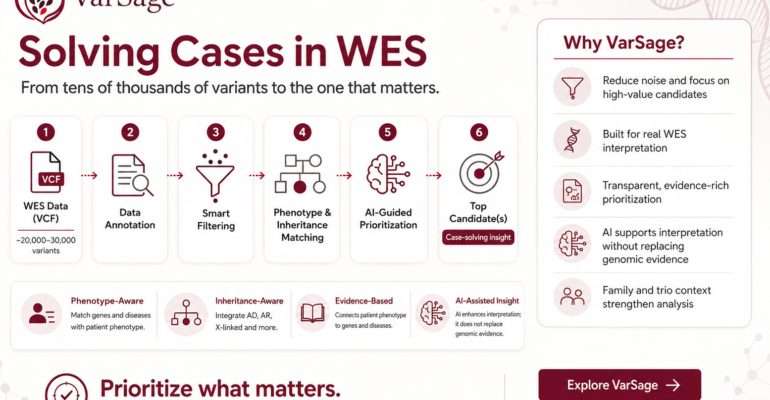
A conventional exome VCF may contain approximately 20,000-30,000 variants depending on the sequencing and variant-calling workflow.
Only a very small fraction are likely to explain a rare genetic disorder.
VarSage approaches this as a multi-stage prioritization problem. Variant information is progressively evaluated using evidence such as:
- population allele frequency;
- predicted functional consequence;
- pathogenicity evidence;
- known disease associations;
- gene-level information;
- patient phenotype;
- expected mode of inheritance;
- genotype and zygosity;
- available family information;
- computational prediction scores; and
- external genomic knowledge sources.
The objective is not simply to remove variants. It is to rank the remaining evidence in the context of the individual being investigated.
Phenotype-Aware Analysis
One of the most important distinctions between generic VCF annotation and disease-oriented variant analysis is the use of phenotype.
For rare-disease investigations, the same variant may deserve very different levels of attention depending on the patient’s clinical presentation.
VarSage allows phenotype information to become part of the prioritization process. Candidate variants can therefore be considered not only according to their molecular properties, but also according to whether the associated gene and disease provide a plausible explanation for the observed phenotype.
This changes the question from:
“Is this variant potentially damaging?”
to the much more relevant question:
“Could this variant plausibly contribute to this patient’s phenotype?”
Inheritance-Aware Variant Prioritization
Phenotype alone is not sufficient.
A variant in a disease-associated gene can still be inconsistent with the genetic model expected for a particular condition.
VarSage therefore incorporates inheritance information into the prioritization process. Depending on the available case information, variants can be evaluated in the context of patterns such as:
- autosomal dominant;
- autosomal recessive;
- X-linked inheritance; and
- other relevant genotype–disease relationships.
Considering phenotype, sex, genotype, family structure, and inheritance together can substantially reduce the number of biologically implausible candidates presented to the analyst.
Population Frequency as More Than a Single Database Field
Population frequency is one of the most powerful filters in rare-disease variant analysis.
A variant observed at high frequency among healthy individuals is generally unlikely to explain a highly penetrant rare Mendelian disorder. However, relying on only one population database can be problematic because representation differs substantially between populations.
VarSage therefore uses population-frequency evidence as an integrated component of prioritization rather than treating a single allele-frequency value as the entire answer.
This is particularly important for variants that may appear uncommon in one dataset but are considerably more frequent in another population.
AI as an Interpretation Layer – not a Replacement for Genomic Evidence
Artificial intelligence is increasingly being introduced into genomic analysis, but its role needs to be carefully defined.
VarSage is designed around the principle that AI should complement evidence-based bioinformatics rather than replace it.
Deterministic genomic evidence remains fundamental to the workflow. AI-assisted components can then help interpret relationships between the patient’s phenotype, candidate genes, variants, inheritance patterns, and accumulated evidence.
This separation is important.
A language model should not decide that a variant is pathogenic simply because its textual description sounds convincing. Instead, AI is most useful after structured genomic evidence has already been collected and evaluated.
The result is an approach in which computational filtering reduces the search space while AI-assisted reasoning helps organize and interpret the remaining candidates.
Beyond a Single Rare-Disease Workflow
VarSage is being developed around different types of germline analysis rather than forcing every case through the same filtering strategy.
Rare-Disease Analysis
The rare-disease workflow focuses on identifying variants potentially responsible for a patient’s phenotype.
The analysis combines variant characteristics with phenotype and inheritance information to produce a prioritized set of candidate variants for further investigation.
Carrier Screening
Carrier screening addresses a different biological question.
Instead of asking which variant explains an affected individual’s phenotype, the objective is to identify potentially important pathogenic or likely pathogenic variants associated with recessive or otherwise relevant inherited disorders.
Separating these workflows matters because the logic appropriate for a rare-disease case is not necessarily appropriate for carrier screening.
Trio Analysis
Family data can provide some of the strongest evidence available during Mendelian disease analysis.
Comparison of a proband with parental genotypes can help identify patterns such as:
- possible de novo variants;
- recessive inheritance;
- inherited dominant variants;
- candidate compound-heterozygous configurations; and
- variants inconsistent with the expected family segregation pattern.
Integrating these relationships directly into variant prioritization can dramatically reduce the manual work required when investigating family sequencing data.
Moving Beyond the Traditional “Annotation Table”
Many variant-analysis systems ultimately produce a very large table.
Although such tables contain valuable information, presenting more columns does not necessarily make interpretation easier.
The underlying design philosophy of VarSage is therefore to move from annotation-centric analysis toward decision-oriented analysis.
Instead of requiring users to manually reconstruct the significance of every annotation, the platform attempts to organize evidence around the questions an analyst is actually trying to answer:
Why was this variant retained?
How well does the associated disease fit the phenotype?
Does the genotype fit the expected inheritance model?
How rare is the variant across available populations?
What evidence supports or weakens this candidate?
Which variants deserve to be investigated first?
This makes prioritization more transparent and potentially more useful than simply assigning another numerical score to each variant.
A Tool for Researchers and Genomic Analysis
VarSage is particularly relevant to researchers, bioinformaticians, human geneticists, and others working with exome-derived variant data who want to investigate candidate disease variants without manually assembling numerous independent analysis steps.
Its role should nevertheless be understood correctly.
Computational prioritization can identify candidates and organize evidence, but it does not replace expert interpretation, segregation analysis, functional investigation, or validated clinical procedures where these are required.
For research-oriented analysis, however, reducing tens of thousands of variants to a manageable and evidence-rich candidate set can save substantial analytical effort.
Why Tools Like VarSage Matter
Sequencing is becoming easier and cheaper day by day.
Interpretation is becoming the main bottleneck.
As genomic datasets grow, the next generation of variant-analysis tools will need to do more than annotate variants. They will need to integrate molecular evidence with phenotype, inheritance, population genetics, family structure, and knowledge from multiple biological resources.
VarSage represents an attempt to bring these components together into a single analysis environment: from raw variant lists toward explainable, patient-contextualized candidate prioritization.
The broader goal is straightforward: spend less time navigating disconnected databases and more time investigating the variants that have a plausible biological reason to matter.